Biodiversity and Conservation Research Group Collaborates on Wildlife Conservation Education Program
As part of its research and conservation activities for the Ngô Văn Trí’s sand lizard (Leiolepis ngovantrii) in Ho Chi Minh City, the Biodiversity and Conservation Research Group of the Institute of Theoretical and Applied Research, Duy Tan University, led by Dr. Ngô Ngọc Hải, collaborated with the Institute of Biology, the Ho Chi Minh City Management Board of Special-Use and Protection Forests, and Xuyên Mộc Secondary School (Bung Rieng Campus) to organize an outreach and education program entitled “Protect Species – Preserve Ecosystems – Join Hands for Nature.”
The program was supported by ZGAP (Zoologische Gesellschaft für Arten- und Populationsschutz – Zoological Society for the Conservation of Species and Populations) and Duy Tan University. It aimed to raise students’ awareness of biodiversity, the importance of wildlife, and the need to protect species and their natural habitats.
Through educational talks, visual materials, interactive discussions, and communication activities, students had the opportunity to learn about biodiversity and wildlife, as well as the characteristics, habitat, and conservation significance of the Ngô Văn Trí’s sand lizard (Leiolepis ngovantrii).
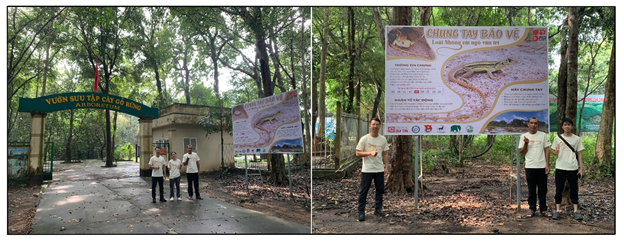
Photo: Dr. Ngô Ngọc Hải with teachers and students of Xuyên Mộc Secondary School beside the program poster at Binh Chau–Phuoc Buu Nature Reserve.
Inspiring Students Through Art
A highlight of the program was a drawing competition focusing on biodiversity and environmental protection. The competition attracted students from Xuyên Mộcc Secondary School (Bung Rieng Campus), with more than 60 artworks submitted.
Through their drawings, students expressed diverse perspectives on nature, wildlife, forest conservation, environmental protection, and the Ngô Văn Trí’s sand lizard.

Photo: Selected outstanding artworks from the biodiversity and environmental protection drawing competition.
The Organizing Committee selected five outstanding artworks for awards, including one First Prize, one Second Prize, one Third Prize, and two Encouragement Prizes. More than 100 additional participation awards were presented to recognize and encourage the involvement of students across the school.
The program also provided five scholarships to students facing difficulties, encouraging them to continue their studies and pursue their educational goals.
Bringing Conservation Closer to the Community
Alongside educational activities, the research group developed a range of communication materials, including educational signboards, T-shirts, notebooks, and keychains. These materials helped communicate messages about nature and wildlife conservation in an engaging and accessible way to students and the wider community.
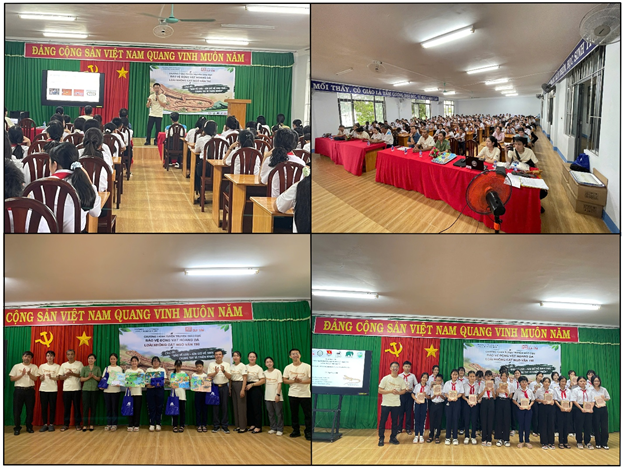
Photo: Selected activities conducted by the research group as part of the program.
The program provided an opportunity to connect scientific research with environmental education and community-based conservation. By bringing knowledge about biodiversity and wildlife directly to students, the initiative helped foster greater appreciation of nature among the younger generation.
At the same time, the program encouraged students to become “young ambassadors working together to protect nature,” contributing to long-term efforts to conserve biodiversity and natural ecosystems.